Tuesday, 16 September 2014

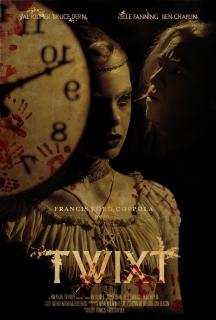
Twixt - a bad, stupid bad movie


At the end of Twixt it’s revealed that everything was just a story that the main character was writing. Now some people reading this might be angry that I spoiled the ending. You shouldn’t be. I saved you time. I had to spoil this because it’s stupid, lazy bullshit that’s sums up the entire movie. It’s nonsense on the same level of ‘it was all a dream’, the sort of bastard storytelling that kids get beaten out of them in grade school. If you pull that crap in a novel, you’ll be laughed at so hard you’ll lose your literacy skills. It’s inexcusable.
And it’s particularly inexcusable here in Twixt, a subpar tepid 'horror' flick, especially so considering the director it came from – Francis Ford Coppola. The man should know better. He should also have crafted a better movie, because this one is terrible. Bland, boring and dull, with subpar acting and filmmaking and a thin layer of pretention spread over its nothing story – Twixt is a bad movie made by a once great director.

I don’t have pictures because I only rented the movie (thank god) so I’ve added pictures from other, better Coppola movies.

The cat in this scene from the beginning of The Godfather must be high as shit on catnip, since it keeps rubbing itself lovingly on Marlon Brando
Horror novelist Hall Baltimore (played by Val Kilmer) is struggling. He made his fame writing witchcraft-themed horror stories, but since then his popularity has vanished and while he’s expected to churn out more witchcraft-based stories he finds it immeasurably dull. The final insult-to-injury is the humiliating book signing he attends in a small town – he’s set up at the back of a tool shop and nobody knows or cares who he is.

He’s approached by town Sheriff LaGrange, a wannabe writer who wants to collaborate with Hall on a book about vampires regarding a series of unsolved murders in town. LaGrange, eager to sell his idea to Hall, takes him to the morgue to show him the body of a dead girl with an iron pole impaled through her chest – the latest murder by a local serial killer.

That night Hall has a strange dream where he meets a mysterious young girl named V who claims to be a vampire. She tours him through the town and tells him about the mysterious history of many of its landmarks, including an abandoned hotel Edgar Allen Poe once visited, a clock tower with seven faces which tell different times, an orphanage with a dark past and the riverside camp where a bunch of goth teenagers thought to be Satanists hang out.
Waking from the dream, Hall becomes convinced that he needs to write a book about the place. Thus he stays, determined to return to his dreams and find inspiration while also looking into the murder. What follows is a series of scenes and dream sequences where Val Kilmer tries to write his book and attempts to solve the murder and uncover the secrets of the town.

Smell, Napalm, Morning, Surfing, Blah Blah Blah
Val Kilmer is a strange actor because the quality of his acting is entirely dependent on the size and scope of his role. He’s excellent as Doc Holliday in Tombstone, and his minor support roles in Kiss Kiss Bang Bang and Bad Lieutenant: Port of Call New Orleans were great. In all these roles he played second or third fiddle to other, better actors and he shone through (Doc Holliday steals every scene from Kurt Russel in Tombstone).

It’s when you give him a whole movie where you realise how little of a shit he gives. He was a boring Batman, and as Hall he’s even more boring. He doesn’t act so much as he stands around reading his lines. A scene where he’s meant to have writer’s block involves him sitting there with a blank expression on his face, which is the same exact expression he uses when he’s investigating a haunted clock tower, viewing a corpse or digging up a coffin in a dream.

The rest of the cast? They appear occasionally (most of the film is just Kilmer), but none are memorable and some don’t even have names. The only two recurring characters are V and the Sheriff, and the former does nothing other than talk about her backstory while the latter acts kooky but isn’t involved much. The rest are mostly there for single scenes, never doing anything and mostly being their costume (the leader of the goth kids looks like a goth and has no other characteristics). 

Gary Oldman Dracula, from a movie actually about vampires
Half the movie is dedicated to slow, dull dream sequences. That’s where everything happens. They’re shot in black and white, with occasional splashes of colour (like some red on V). Sometimes Hall wanders around the town. Sometimes he talks to V about how she was molested by a priest, who then murdered a bunch of children while she ran away (more stupid spoilers, but whatever - none of it happened anyway). Hall hangs out with Edgar Allen Poe a few times who talks about the importance of endings (which is silly due to Twixt’s final cop-out) and helps him get over the death of his daughter. The whole ‘Hall’s daughter died and he feels responsible’ thing is an example of the incredibly loose narrative threads that are rife in the film – it’s hinted to maybe once, and then the film suddenly decides it’s really important, only to drop it completely afterwards. Same with the mystery of the clock tower and solving the murder and all of this other crap.

As a result of the constant dream sequences, we also get a whole lot of scenes of Hall lying in bed, falling asleep or getting knocked out so he can have a dream sequence. They happen a lot, to an almost laughable degree.

The film is billed as horror but good luck finding any thrills or chills. Nothing frightening, atmospheric or creepy happens and there's no gore. The things that do occur are boring clichés. There's a scene where Hall and a few others use a Ouija board to talk to spirits which is so tame and lame that it's almost a parody of other films that use Ouija boards, only Twixt takes it seriously. The 'vampire' angle adds nothing to the film at all, features into none of the plot and is only mentioned once or twice.

 
Keanu Reeves could potentially use his wooden acting to kill Vampires
Twixt is a bad movie and confusingly so. I mean that in the sense that it’s confusing that it’s as bad as it is. Francis Ford Coppola has made three excellent movies that are worthy of being deemed classics – the first two Godfather movies and Apocalypse Now. How he could go from them to direct something as bland, as dull, as bad as this is astounding. Now granted he’s directed his share of crappy movies (‘Jack’, in which Robin Williams plays a thirteen year old boy with the body of Robin Williams), but this just takes the cake. It smacks of disinterest and a lack of effort. Nobody seemed to give a shit in any aspect of the film.

It’s also a visually dull film, which is astounding considering Coppola’s previous pedigree. ‘Bram Stoker’s Dracula’, for all its faults (and there are many), was visually vibrant and interesting. Twixt is visually bland and uninteresting. The black and white (with an occasional bit of colour) dream sequences are more drab than artistic, and have no meaning whatsoever.  

There's no caption here. I'm done.
The ending twist, that it was all a story Hall was writing, is preceded by a stupid ‘shock’ scene (the dead girl in the morgue is V, Hall pulls the iron pole out, she comes back to life as a vampire and attacks him). Then you switch to him in his editor's office with the manuscript, and the editor praising the ending (no sane editor would praise that ending). It was all a story, and not even a good one. It also leaves a lot of questions as to whether anything actually happened – did Hall even go to the small town? Not that it matters at all. Nothing matters. The only thing anybody will take from this is disappointment.

Tuesday, 9 September 2014

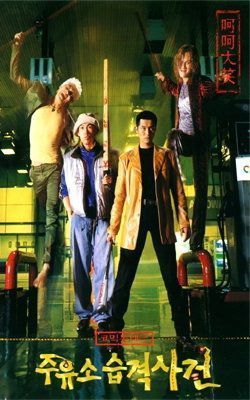
Attack the Gas Station


As far as descriptive titles go, it’s a pretty apt one for this oddball South Korean comedy. Four bored, disillusioned youths attack and rob a gas station, trashing the place, terrorising the employees and making away with some cash. A few days later, they get bored again and rob the same gas station. This time the manager hides the money, so the four take the employees hostage and take over the gas station, pumping gas for customers and pocketing the money.

What follows is an strange night where they beat up a bunch of people, take a lot of hostages, force the hostages to fight each other, pump gas, antagonise customers, order Chinese take-out, antagonise the Chinese delivery man, antagonise the police and smash up the gas station a few more times. By the end a full-on street brawl has erupted between gangsters, angry take-out drivers and the police.
Underneath all of this are brief snippets of the main four that show reasons for their disillusionment. These segments give a little insight into the personalities of the main four, which helps because there isn’t much to most of the characters. The movie has fun with its premise, and is fairly entertaining for what it is, but it’s lacking that certain something to lift it up.

 
It’s not really about anything. Barring the central premise of ‘guys take over gas station, hijinks ensue’, there isn’t really anything of a plot structure. There is a gradual sense of progression as the night goes on, but otherwise it’s a series of fairly humorous events slightly linked until the morning where it ends. That ending itself is sort of shrug worthy, though the end credits give snippets of what happened to each character afterwards.
There is a sense of escalation and recurring events. The four of them continue to piss off a lot of different people, often with direct consequences of each other. They constantly antagonise a Chinese delivery man, causing him to form a posse of angry delivery men. Most events lead into each other directly, giving the escalation a sense of meaning. Otherwise the focus is mostly on the characters, which is odd because they are all pretty basic really.

The four attacking youths are the film’s heroes, and while it’s mostly a comedic light-hearted affair and played for laughs, some of the stuff they do is concerning and dangerous. They take two people hostage and lock them in a car boot, where they remain completely forgotten for the rest of the movie (to the point where it’s an honest question as to whether anybody will find them). They instigate two car accidents, beat a lot of people up and do some other pretty sketchy and dangerous stuff. While their anger and disillusionment is given some brief outlining, it’s a pretty thin reason for us to take their side as they terrorise the gas station.

 
No Mark, the leader, is odd. He spends a lot of the movie basically being a villain. He’s the most serious of the group, constantly threatening and assaulting the manager. He’s the most calm and collected of the group, but also responsible for the more illegal plans and ideas. His backstory might be a culturally specific one – he has the stigma of being an orphan. Honestly it’s sort of hard to really get behind him, he’s played straight so he comes across as a villain more than anything for the most part.
Mad Dog, the dumbest of the group, is fun. He carries around a wooden beam that he constantly makes use of. His job for most of the film is handling the ‘hostages’, which often involves making them lie down with their heads on the ground. He’s probably the most fun character, as his hijinks tend to be less malevolent and more juvenile, and underneath it he has a weird sense of justice.

Paint is the least involved and interesting of the four. He’s a painter/artist whose dreams and talents are trashed by his angry traditional father who considers his creativity pointless. He does some painting I guess, but he leaves the smallest impression of the group. There are side characters that get more attention than he does.
Rockstar is the most aggressive by far, often the first to violence. He spends a lot of the movie angry and annoyed at the lack of good music, forcing some of the hostages to sing for him, leading into a random music number (a lot of these Asian movies tend to do the ‘random music number’ thing). 

The gas station’s manager can’t help but antagonise the four, leading to further conflict. He constantly talks back, constantly riles them up and also constantly pays for it. It gets to the point where you wonder why he doesn’t just get with the program and keep his mouth shut, but I guess in a South Korean context it might make sense – he’s an adult and being talked down to and disrespected by a bunch of youths.
The rest of the characters are vaguely defined. Asides from the constantly-suffering gas station manager, there’s three employees, only one of which has any sort of defining features (he sort of develops a little bit of Stockholm syndrome and confidence when, forced to fight his school bullies, he actually wins). The majority of the ‘characters’ are the random people who turn up at the gas station, from lazy police officers to music producers and allsorts. None really have much of an impact.

Oddly not a single character emerges as the focal point. Not even any of the main four, with the film spreading its attention thinly amongst them. You learn very little about anybody, and nobody changes or grows as a person.  

 
This is going to sound really weird, and bear with me for this, but the movie feels a bit like a Korean teenage douchebag version of Clerks. While they are largely completely different films in almost every single aspect, they both have a similar sort of feel. It’s about disillusioned, aimless youths confused about the world, themselves and where to go with their lives, largely avoiding these questions through shenanigans. It’s also just a bunch of random, humorous things happening in place of a plot. Much like Clerks, it’s also about the everyday oddness of working in a mundane environment and the sorts of people who patronise those places. Weird, angry people tend to turn up at the gas station, while the four tend to harass them and take their money.

It’s also has some culturally specific themes, regarding South Korea culture, where cultural differences come into play. What I assume to be a Korean phonetic word game is played by two of the characters with zero explanation, while certain quirks seem Korea-specific. The filmmaking is fine, with occasional stylistic edits. The movie almost completely takes place in and around the gas station, rarely venturing outside of its confines.  

 
Attack the Gas Station pretty much does what it says on the tin. A gas station gets attacked, there’s some humour and a little action thrown in. It’s fairly entertaining but it also never really ascends to anything particularly special. 

Wednesday, 27 August 2014

Project A

Project A might as well be the quintessential Jackie Chan movie. The film, which he wrote and directed, is filled with all the things that would come to characterise his movies - death-defying stunts, fast-paced action scenes and slapstick physical humour. It might feel a little bit dated in terms of technical filmmaking and some weird cultural quirks appear, but otherwise this is something of an early landmark film in Chan’s career, where he formed his own style of filmmaking that would come to characterise the films he would go on to make.   

 
Jackie Chan plays Dragon Ma, a sergeant in Hong Kong’s coast guard in the 1800s. The coast guard has a strong rivalry with the police force, as while the police keep the streets safe, the coast guard are unable to handle the violent band of pirates which constantly attacks British ships across the South China Sea.

When the coast guard’s ships are destroyed, leaving the large force ineffective, Ma and his team are forced to become police officers, training under his law enforcement rival Officer Hong (Yuen Biao). But apparent corruption in the police force linked to the pirates causes Ma to leave the force and take justice into his own hands. Teaming up with an opportunistic troublemaker named Fei (Sammo Hung), Ma becomes determined to bring the pirates and criminals to justice.

It’s a pretty simple plot that’s more of an excuse for the series of action/stunt/comedic set pieces that are spread throughout the film.

 
The stunts and action set pieces are really great fun, and back then set the bar for what was expected from Jackie Chan action flicks. The fights in this film, compared to earlier Chan action flicks like ‘Young Master’ and ‘Drunken Master’, are far more free and ‘adaptive’. Instead of the stiff sort of combat older chop-socky films employed, Project A shows off the sort of Jackie Chan action he would be come to known for. His fight scenes have him against groups of opponents, where he takes them on simultaneously, alternatively attacking and fleeing, and using a lot of weapons and objects. Chan swings from chandeliers, flips over chairs and throws bottles and pots during the action.
The action isn’t solely made up of fight scenes. Chase sequences and assorted hijinks ensue. One set piece has Chan and his pursuers on bicycles, riding through narrow streets. It’s a lot of fun, leading to some amusing stunts. This main antagonist, San-Po, gives a great final fight, with the combined forces of Chan, Hung and Biao being needed to take him down (though they do cheat and sort of kill him horribly).     

Project A also has one of the quintessential Jackie Chan stunts, the clock tower fall. Chan hangs from the hands of a clock tower face and falls, passing through two awnings, before hitting the ground. Apparently Chan was too afraid of letting go of the clock hand, so he ordered his film crew to continue to film him as he held on as long as he could before his arms got tired and he slipped off. And when he wasn’t happy with the first take, he did it again. And then again. Chan was determined to get his stunts right, even when they were causing him substantial physical pain.


Dragon Ma is the quintessential Chan character – righteous, well-meaning, often jokey and sometimes foolish (often prone to accidents). It’s a role he plays a lot, in titles like Armour of God, Police Story (and even in his American films like Rush Hour and Shanghai Noon).
If Dragon Ma is the quintessential Chan role, then Fei is the quintessential Sammo Hung role. Sammo Hung is a Chinese actor/martial artist/choreographer and a contemporary of Jackie Chan and Yuen Biao (they trained together as children in the same performance troupe and largely dominated Hong Kong’s action film scene in the eighties and have worked on many of films together – Biao also co-stars in Project A as Inspector Hong). Hung mostly played cheeky, sometimes goofy troublemaker roles (though in his older age he now seems to exclusively play gangsters), and his role as Fei is no different.

This is a personal opinion of mine, but I feel that if Hung made a similar breakout in America around the time that Chan did he could possibly have seen a somewhat similar Western popularity. While he didn’t do the ridiculously dangerous stunts that Chan is famous for, his action choreography is exceptionally solid and his boisterous and cheeky personality is quite funny (though, once again, he has traded that out in his older age).
Yuen Biao, as mentioned before, is a contemporary of Chan and Hung, offering a more acrobatic athleticism. His role as Inspector Hong is, oddly, far different to the sorts of roles he usually played. He tended to play enthusiastic underdog characters (as in The Prodigal Son and Zu Warriors from the Magic Mountain), but his role as Inspector Hong is strangely stoic, though he gets his fair share of action. 


One issue is the fairly loose and lax plotting, with the moving sometimes feeling a bit aimless and long. While there is a story there, it’s not particularly important, more of an excuse to stage the various action and comedy set pieces throughout the film. The coast guard’s training to become police officers aspect of the plot seems to solely exist for the ten minutes of largely physical comedy and hijinks that makes up their training. The conflict with the pirates doesn’t really come into play that much, while most of the film is a loose collection of slapstick encounters and chase scenes. 
Chinese humour is weird. I feel I say some variation of this in every Asian movie I look at, but from a western perspective the humour used is strange. Often the jokes are of the groan-worthy kind or weirdly childish and bizarrely telegraphed. During a bar brawl one guy announces his plan to throw a plate of spaghetti at his opponent. He ends up face-planting into the spaghetti himself because of course he does. A lot of these earlier Hong Kong action flicks have the same sort of weird humour, so I can’t exactly blame Project A too much, but I still feel it’s odd.

 
Project A is a fun movie with entertaining action and stunts. More importantly, it’s a movie that perfectly encapsulates its main star and the shape of the Hong Kong action movie scene at the time. It’s definitely worth watching (and its sequel too), especially if you’re a fan of Jackie Chan, though if you haven’t been exposed to old Hong Kong action films before it may seem a little strange.  

Tuesday, 19 August 2014

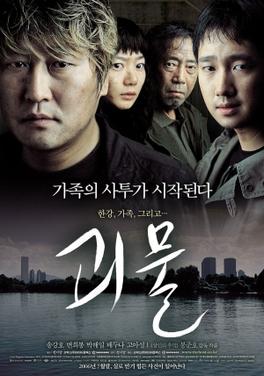
The Host


The Host is a really good Korean creature feature. It adds in so much more than your everyday monster movie, and is ultimately a really strong film for it. It also seems to break from most of the creature feature conventions. You see the creature clearly, in full daylight, going on a rampage within the first fifteen minutes. The focus is on a small family, but the characters are interesting and the acting is good so you actually care about them. The Host is memorable and entertaining, and worth watching.
Lazy simpleton Gang-du works at a riverside food stall in Seoul with his elderly father. He’s an often absent-minded buffoon of sorts, prone to sleeping on the job and who only perks up and shows care and enthusiasm towards his schoolgirl daughter Hyun-seo. His sister is a competitive archer and his brother is an unemployed college graduate/alcoholic/political activist.

One day a creature comes out of the Han River and goes on a bloody rampage, killing dozens of people. Gang-du attempts to fight it off and flee with Hyun-seo, but in the panic and confusion she is taken by the monster as it retreats back into the river. Military forces immediately lock down the city, evacuate the citizens and close off the area while quarantining anybody who remotely came in contact with the creature due to their fears of it possibly spreading a deadly virus. Gang-du and his family are taken to a military hospital where they grieve, but in the middle of the night he receives a brief, panicked phone call from Hyun-seo, still alive and in the creature’s lair, Gang-du and his family must then work together to escape the quarantine, evade the military and rescue Hyun-seo before the creature kills her.


The quarantine aspect of the movie really gives it a different feeling. There are roadblocks, there are armed soldiers, there are doctors in containment suits, there are trucks driving along the river releasing decontaminating steam to ward off the possible virus. As such the riverside and sewers feel abandoned, which makes sense considering. It really feels like what a government/military reaction to the sudden appearance of a monster would be like. The film ventures into the labyrinthine sewers under Seoul (shot there for real), which are surprisingly atmospheric. They’re large, grey mazes of cold, angular architecture and are a pretty interesting locale for a horror movie.
The creature in this feature is an interesting one, a sort of mutant tadpole/frog thing. It’s not as large as many other monster movie monsters (it’s a little larger than a van), but it’s surprisingly agile and versatile, being amphibious and sporting a prehensile tail. It swallows people whole and then vomits out their bones in a grossly awesome bit of monster detail. It looks pretty great all things considered. While the CGI is a bit dated (the film was made back in 2006) the design is still really interesting and unique.

There’s an occasional streak of gallows humour thrown in to add some levity to situations that continue to get increasingly desperate and grim. It’s a pretty good mix all things considered, though as it continues to the end the humour largely vanishes. It’s occasionally a more serious and sombre monster movie than most, and the focus on a single family is surprisingly effective.
 
The acting is quite good, which is something that is usually lacking in monster movies. Monster movies usually fill the non-monster segments of the film with dull characters doing nothing interesting. The Host, more than anything, is about Gang-du’s family and focuses on them. And it really works; the family dynamic is interesting, and they have enough quirks to be interesting. Each family member also has their part to play. You actually end up caring for their plight. It works because they ~ cares a lot about his daughter – she’s his whole world. His desperation and determination, borne from an otherwise simple and lazy individual, really works well. Actor Song Kang-ho is great as Gang-du. He’s a mainstay in a lot of great Korean movies, also starring in ‘Sympathy for Mr Vengeance’, ‘The Good, The Bad, The Weird’ and ‘Thirst’, and he does good work here.
A big ongoing theme in the film is failure, particularly with Gang-du and his siblings. His sister is an excellent archer, but loses competitions as she hesitates. His brother is another sort of failure – an unemployed college graduate/alcoholic and political activist. His father feels guilty for his son’s usual laziness. As the film goes on, they step up and take charge, but sometimes mistakes are still made – that’s just life. Military and government incompetence is a big theme in the movie, with the various soldiers, government officials and scientists being ineffectual and uncaring. Gang-du and his family are constantly hindered by incompetent officials and uncaring doctors.

It’s a well-made film from a technical standpoint. It’s a good looking movie, shot well with a good colour scheme that really sells the atmosphere. Likewise the sound design is excellent, with the instrumental them being particularly noteworthy.


The Host is a good movie and well worth watching. I don’t really know how to elaborate on that.

Thursday, 14 August 2014

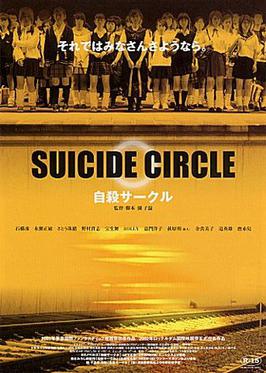
Suicide Club


It sucks. The premise is interesting at least, seemingly offering a creepy mystery, but then the movie chooses not to make proper use of it. Instead you have an oddly paced, disappointingly sombre and dull J-horror offering that frustrates as it constantly threatens to become interesting but never makes it there. The characters are dull and lifeless, meaning you never care either way. The initially creepy atmosphere is dragged out and then starts to turn outright silly while the movie continues to take itself stone cold seriously. It also never leads anywhere, just plodding along until it eventually stops.

Director Sion Sono is a weird guy. I’ve reviewed a film of his before, the ridiculous ‘Why Don’t You Play in Hell’, and I also enjoyed the oddness of his four hour epic ‘Love Selection’. But I really couldn’t get into ‘Suicide Club’. I just didn’t enjoy it.


Fifty cheerful Japanese schoolgirls commit mass suicide by throwing themselves in front of a moving subway train, causing widespread panic and a sudden suicide epidemic across the country. Left at the scene, and at every other scene of such significance, is a bloodied bag containing a rolled up length of stitched-together human skin taken from the victims before their deaths.

A mysterious website which keeps a tally of the suicides by gender (though the tally increases before the suicides), small children who start calling the police and giving them cryptic warnings and a violent glam rocker/cult leader named Genesis all seem linked to the ‘Suicide Club’. Seemingly connected to all of this is the cheerful pop band ‘Dessart’. The bewildered police, a hacker named the Bat and a schoolgirl all get caught up in the mystery behind the suicides.

Now all of this sounds interesting, but never manages to actually be interesting. It’s never given adequate treatment, most of it being odd sort of details that don’t add anything. It’s all sort of a dull mess, with every new revelation fizzling out as the movie refuses to delve deeper.

The movie’s pacing is also off. After the gory opening subway scene, there’s an oddly prolonged, entirely unrelated scene in a hospital that attempts to build atmosphere but just slows the movie down suddenly. And it continues like this for most of the movie actually – there’ll be an interesting, intriguing scene that’ll push the story forward, followed by a long sequence of nothing important (usually leading up to a suicide). The slow building atmosphere doesn’t do much, especially towards the end when things get downright silly. But the movie refuses to budge from its squalid pace, dragging on in this fashion, getting weirder (but never interesting) as it trudges on to a non-ending that doesn’t satisfy.

It’s really hard to care about what’s going on, as we aren’t given any characters worth caring about. None of them have any depth, and they only get given occasional focus. The movie spends much more time showing slow burn scenes of people randomly killing themselves. The few main characters mostly don’t have anything going on (especially the schoolgirl), and most of them kill themselves anyway. I guess one could argue that, thematically, it’s about the real-life unexplained high suicide rate in Japan, but that feels like a copout.  
It’s never as interesting or entertaining as its premise threatens to be. Part of the reason is the really dull and serious tone it takes, even when ridiculous things are happening. Genesis hangs out in an abandoned bowling alley with large sacks full of writhing animals and girls he and his gang routinely murder. Yet it’s never creepy or ridiculous enough to be entertaining. The cryptic children talk in nonsense riddles and speech, doing nothing more than being clichés, and a lot of the supposedly ‘chilling’ imagery is nonsense.

                                         
It’s often downright silly (everything about Genesis), but it takes itself so seriously there’s no fun to be had. It’s too silly to take seriously, and too serious to be fun. It just sort of exists in that vague middle space. The effects all look ridiculously fake, with CGI nonsense for most of the explosive gore, and large sprays of fake blood gushing around in the bigger scenes. The filmmaking is also quite simple for the most part, almost made-for-TV at times (everything in the hospital could pass for something shot for a TV drama).
At the end, like most J-Horror, the mystery goes largely unresolved. The best J-Horror has always had a vein of ambiguity and mystery, where not everything is explained. But while this works in adding to the creepiness of many J-horror classics, like The Ring or The Grudge, here it just ends things unsatisfactorily. The movie just sort of finishes at that point, with most of the characters dead, the mystery continuing and the audience feeling apathy. It doesn’t even have a final scare, it just ends vaguely.

                                              
Suicide Club isn’t worth it. It has an interesting premise that it never capitalises on, being a disappointing, meandering slog of nonsense and frustration as good ideas go squandered. Don't bother. If you want a creepy J horror movie that’s actually good, there are plenty of better titles to check out, like the Ring, the Grudge, One Missed Call and the Eye (all of which have received American remakes btw).  

Monday, 11 August 2014

Wild Zero


What the hell can one say about Wild Zero? Depth and substance are mostly abandoned in favour of explosive style, overwhelming coolness and extreme loudness. Wild Zero doesn’t give a fuck about what you think, it just does whatever the hell it wants to. Rock and Roll? Hell yeah! Zombies and aliens? Sure, why not! Guitar Wolf angrily sculls a beer a few times for no reason, some guy’s head explodes just because and the main villain runs around in his underwear. Jets of fire come out of motorcycles, microphones and just about everything, there are about two dozen explosions, most of them random, some zombies can talk and one guy starts shooting lasers out of his eyes. Why? Because fuck you, that’s why.
It’s loud, it’s ridiculous and it’s sort of all just about J-Rock band Guitar Wolf looking cool. But that’s perfectly fine. The sheer energy this film has is overwhelming and infectious. Wild Zero is a really fun movie.


Ace is the Number 1 Super Fan of J-Rock band Guitar Wolf. He follows them when they’re playing in seedy clubs and is determined to become a rock and roll superstar to rival them. When he accidentally aids them in a violent standoff with a deranged club manager named Captain, he becomes blood brothers with Guitar Wolf, who gives him a whistle to blow (which might be magic) if he’s ever in need of help.
Meanwhile, a meteorite shower in the desert (caused by aliens) has caused an outbreak of zombies that are slowly spreading towards Asahi city in Japan. Ace falls in love with Tobio, a gas station clerk who isn’t what she seems, after accidentally foiling a robbery attempt. As the zombie onslaught gets into full swing, Ace needs Guitar Wolf’s help to fight the zombies, rescue the girl (?) and save the day. He blows the fabled whistle and Guitar Wolf comes to help out, while also being hunted by the psychotic Captain, determined to get revenge. 


The enigmatic Guitar Wolf, with his bandmates Drum Wolf and Bass Wolf (who look exactly the same), are portrayed as wandering badasses. They never take their sunglasses off, aren’t phased at all by zombies, aliens or danger and are always cool regardless of the situation. Guitar Wolf himself is some sort of awesome badass of ultimate coolness. He yells and howls all the time, rides a kickass motorcycle (in the shape of a wolf), constantly drinks (there are like three scenes of just him drinking a beer), kills zombies by throwing guitar picks ninja-style and eventually pulls a sword out of his guitar. He also has a weirdly strong commitment to helping Ace, despite only meeting him once (though his ‘help’ seems to consist solely of finding him). At one point Guitar Wolf jumps from an exploding building, strums his guitar in mid-air, lands perfectly and then instantly tunes it as though nothing had happened. It’s that sort of movie.
‘There are no boundaries in Rock and Roll!’ yells Guitar Wolf at one point. It’s one of many such Rock and Roll based pronouncements he makes in the movie. There are a few scenes just of Guitar Wolf (the band) playing songs (often with silly electric special effect shooting out of their guitars, and flames out of their microphones). Their music is comprised entirely of loudness, reverb and yelling – all of which fits with the rest of the movie. This is, all things considered, their movie.

 
Ace is a likeable idiot whose enthusiasm for rock and roll is all-encompassing. Unlike most characters from zombie movies, he actually has something of a character arc and an internal conflict he has to get over (So what if the love of your life turns out to be a shemale? Be courageous and save her! Rock and Roll is love and life!). He constantly sees images of Guitar Wolf egging him on throughout the movie, yelling about Rock and Roll. In fact the words ‘Rock and Roll!’ get yelled out constantly.
Captain, the main villain, has a ridiculous wig and wanders around in his underwear discharging a shotgun constantly. He actually removes his pants expressly so he can go hunt down Guitar Wolf. Eventually he starts to fire lasers out of his eyes, just because it looks cool. All this weirdness makes up for the fact that he lacks any sort of characterisation other than ‘crazy weirdo’.

Other characters include a bickering couple who eventually find true love (as zombies), their somewhat psychotic (and useless) would-be-robber friend and a super angry arms dealer (who gives the movie its brief glimpse of female nudity). One again none of these characters have much characterisation, pretty much being given a single personality aspect and that’s it.

 
Wild Zero is a loud and dirty movie, and this extends to the plotting, directing, effects and cinematography as well. The movie has its issues, but ultimately you probably won’t notice or mind them. Wild Zero is like an explosive music video that goes all out, pumping you full of adrenaline and not giving a damn about the consequences.

At the time of release (1999) there hadn’t been too many Asian zombie flicks, so the zombie make-up is actually pretty good for the time. They have green skin and sallow eye sockets, and look a bit decayed. They act zombie-like and eat a few people, but to be honest they’re not much of a threat in the movie. The zombies are more of a detail than the focus. Same with the flying saucers. Cheesy effects abound. The flying saucers looks super fake to a ridiculous degree. While most gore is prop work, every head explosion (there’re actually quite a lot) is silly looking CGI. The explosions are fun though.
The plot, despite all of the nonsense going on, is really thin and most characters don’t have anything to do with the overall story. In particular Ace’s story with Tobio is completely separate from Guitar Wolf dealing with the zombies, aliens and Captain. Ace himself doesn’t really do much at all, and many of the smaller side characters don’t feature into anything. At times the movie is just a bunch of cool things happening, mostly involving Guitar Wolf. Many scenes with Captain also seem out of place with the rest of the film, particularly the opening which involves drugs and a woman being beaten, and at one point they have a purposefully dull pop idol-wannabe sing a really crappy song for no reason. A lot of the movie has characters either stranded somewhere or returning to the same few locations (everybody keeps going to the gas station).


With so much noise and energy, it’s bound to let up at some point. And it does, with Tobio. Tobio is a bit of a weak point in the movie, not having much to say or do and being more of a plot device than a character. Ace’s character arc and plot with her slows things down a little, particularly towards the end, and his scenes eventually all tend to be about her. Once again, Ace and Tobio don’t actually do much at all in the bigger scheme of things. That being said, these segments do give a little bit of a breather.

From a technical viewpoint the movie isn’t the best. Underneath all the style is competent filmmaking, but it’s not the best looking movie. It’s all style and no substance. It's often quite dark. There are a few inconsistencies and mistakes throughout. The camera crew have a real problem with reflections – in a few scenes you can actually see the camera, and even some of the film crew, reflected in mirrors and windows. In one scene ravenous zombies are trying to get through a large factory sliding door, which has a gap you can see under. Once it’s closed, underneath you can see the feet of the zombie actors who immediately stop being zombies and start walking off. These errors are incredibly minor though, and most probably won’t notice them under the high-octane craziness.

One warning - the Eastern Eye DVD at times can look very pixelated on a large television (though that might just be my copy).

 
‘Love has no boundaries, nationalities or gender’. That’s the ultimate ‘message’ of the film, which is really strange if you think about it. Underneath all the explosions, zombies and rock and roll is a message about love and acceptance. Of course this gets sort of sidelined and overwhelmed by all the explosions, zombies and rock and roll, but that’s all part of its charm.

Wild Zero is crazy fun, where sound and fury explode on the screen.

Sunday, 10 August 2014

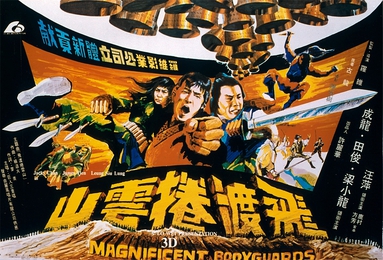
Magnificent Bodyguards


An early Jackie Chan chop-socky flick made at the tail-end of the seventies. While the movie is, for pretty much all intents and purposes, just a footnote in its lead actor’s career, I really like it. It’s fun, it’s goofy (though perhaps unintentionally so) and the action, while as traditional as can be, is entertaining.
Jackie Chan plays Ting, a famous fighter known to have the fastest punches in the land. He’s hired by the wealthy Lady Nan as a bodyguard to help transport her ill brother across the dreaded Stormy Mountain, a place filled with roving bands of violent bandits, led by the notorious Lord Chu. To aid him in his quest, Ting enlists the help of two others, a deaf tailor with powerful kicks named Chang and Master Tsang, a notorious gangster who rips people’s faces off. Together they trek across the Stormy Mountain, wary of Lord Chu’s forces, which include angry bandits and evil shaolin monks.

Jackie Chan, asides from his acrobatic kung-fu skills, is pretty unrecognisable to the action superstar he’ll become (though that might be because of his ridiculous hairstyle). This is early, pre-explosive-popularity Chan, so instead of the usual somewhat-goofy-but-can-kick-your-ass Chan we get confident asshole Chan. Ting has no qualms in outright insulting people he thinks are weaker than he is. It’s fun seeing him in an early role like this, but – interestingly enough – Chan doesn’t steal the movie. While he’s the main character, he doesn’t overshadow anyone else and isn’t constantly the centre of attention. Many of Chan’s movies, especially his duds, traded solely on his presence, but this pre-fame Chan film succeeds independent of him, though he does help thanks to his energy.
                                                                Note Jackie Chan's glorious hair
Master Tsang might as well be a villain. He’s a dude who goes around ripping people’s faces off for fuck’s sake. He harasses thieves by demanding that they pay tribute otherwise he’ll skin them and only joins Ting after he promises him a bunch of money. Within a minute of screen time he cuts a guy’s arms off and then rips off his face, and then for the rest of the movies all he does is talk about skinning people. 
This movie is, at times, surprisingly violent. A lot of the early chop-socky flicks were, often with characters spitting up blood, but Magnificent Bodyguards takes you off guard suddenly. Basically any action scene involving Tsang will end with somebody’s face getting torn off. Doesn’t matter if it’s a woman either, the dude just likes tearing faces off. The action scenes are all that old sort of choreography, with punches, kicks, flips and a rather large variety of weaponry being used. It’s all pretty fun, especially when the weapons start coming out (towards the end deaf Chang pulls out some knives and kicks serious ass, making one question why he never did it earlier). There's also some hilarious nonsense thrown in, like a scene where Jackie Chan is karate chopping snakes that are flying at him.

                                                 This is apparently the correct stance for battling snakes

The movie is also really weird. There’s a dramatic song partway through with lyrics that just describe who the characters are and what they happen to be doing at that moment (walking through a forest). In a few scenes they actuallt use music stolen from Star Wars. At the end they bizarrely do a Scooby Doo styled mask-pulling reveal of the villain that’s completely ridiculous in every way, which is preceded by a twist that’s equally stupid. There’s also a streak of that odd sort of sometimes out-of-place Chinese humour that pops up every now and then, usually in direct contrast to something violent or serious happening. The aforementioned scene of Master Tsang severing both a guy’s arms and ripping his face off (I keep bringing it up because it’s so suddenly brutal) is immediately followed with light-hearted quips at the expense of the dead guy. It’s weird, but not as brutally out-of-place as other similar films from the same time (Iron-Fisted Monk goes from a surprisingly horrific rape scene to some goofy hijinks in a brothel without batting an eyelid).

It was an early 3D movie (the first Hong Kong movie filmed in 3-D apparently), which means that there are a lot of scenes of people punching, kicking or thrusting weapons at the camera (and snakes, lots of snake lunging at the camera). It’s often quite funny, such as watching Jackie Chan suddenly turn to the camera mid-fight to unleash a flurry of punches at you.
A lot of the old chop-socky flicks ended the same way, with a freeze-frame and the words ‘The End’ appearing the second the main villain is defeated. There’d be no epilogue and whatever story threads there were left went completely unanswered. Magnificent Bodyguards does this too, but also jumps the gun, ending with a freeze frame before the heroes deliver the finishing blow. It’s a bit disappointing, but a sign of the time I guess, not that there would have been much of an epilogue (by the end anybody who was even remotely evil dies horribly).


                                 Master Tsang seems a bit obsessed with skinning people

Magnificent Bodyguards is a highly entertaining, though pretty standard old-school kung-fu flick that’s elevated by its weirdness. I can’t say that it’s the best of its kind, but it’s a massive amount of fun.